In every mission‑critical domain — national security, global finance, healthcare, critical infrastructure — analysts face the same reality: the cost of a wrong decision is catastrophic. Yet the tools entrusted with supporting these high‑stakes judgments often function as black boxes, offering little insight into why they flag a risk or recommend an action.
This is where Cogility’s Hierarchical Complex Event Processing (HCEP) model changes the game.
Born from decades of AI research and real‑world operational needs, HCEP delivers transparent, trusted Expert AI designed not merely to process data, but to replicate the reasoning of seasoned human analysts. Our new white paper — Expert AI for High‑Consequence Decision Making — breaks down the origin, architecture, and real‑world impact of this transformative approach.
Below is a concise look at why HCEP matters, and why organizations operating in high‑risk environments are adopting it today. Read the full paper here.
AI Can’t Be a Black Box When Lives or Missions Are at Stake
Many modern AI systems (especially deep learning) are undeniably powerful — but typically opaque: They excel at pattern recognition but struggle to explain themselves. In national security, healthcare, or financial compliance, this is a deal‑breaker. HCEP was designed from the ground up to solve this problem.
Rather than learning opaque parameters narrowly focused on a training dataset, HCEP uses:
- Explicit hierarchical models built by human experts
- Stateful, context‑aware pattern matching
- Event‑driven reasoning
- Continuous probabilistic risk assessment
- Manual analyst overrides with full provenance
Every assessment has a transparent causal chain. Every alert can be audited. Every conclusion can be traced to its originating evidence.
In high‑consequence environments, that transparency is not a luxury — it’s essential.
From Cognitive Psychology to Real‑Time Decision Support
HCEP didn’t appear from nowhere. It synthesizes some of the most influential ideas in AI and human decision‑making:
- Selfridge’s Pandemonium model → early hierarchical pattern perception where simple features combine to form meaningful interpretations
- Expert systems → transparent rule-based knowledge to support reasoning and decision making
- Luckham’s Complex Event Processing → identifying meaningful event patterns in real time to support timely, informed decisions
- Cognitive psychology research → informing human decision-making models that rely on structured knowledge and patterns built from experience
Leveraging these foundational innovations, Cogility’s HCEP architecture implements hierarchical, pattern‑based inference as an operational model for real‑time event processing, converting raw streaming data into actionable insights. Through its integration with modern distributed computing tools (Kafka, Flink, Kubernetes), Cogility produces something truly unique: real‑time Expert AI that scales to enterprise volumes without sacrificing explainability.
The HCEP Advantage: Structured Sensemaking at Enterprise Scale
The white paper details five pillars that set HCEP apart:
- Computation Hierarchy
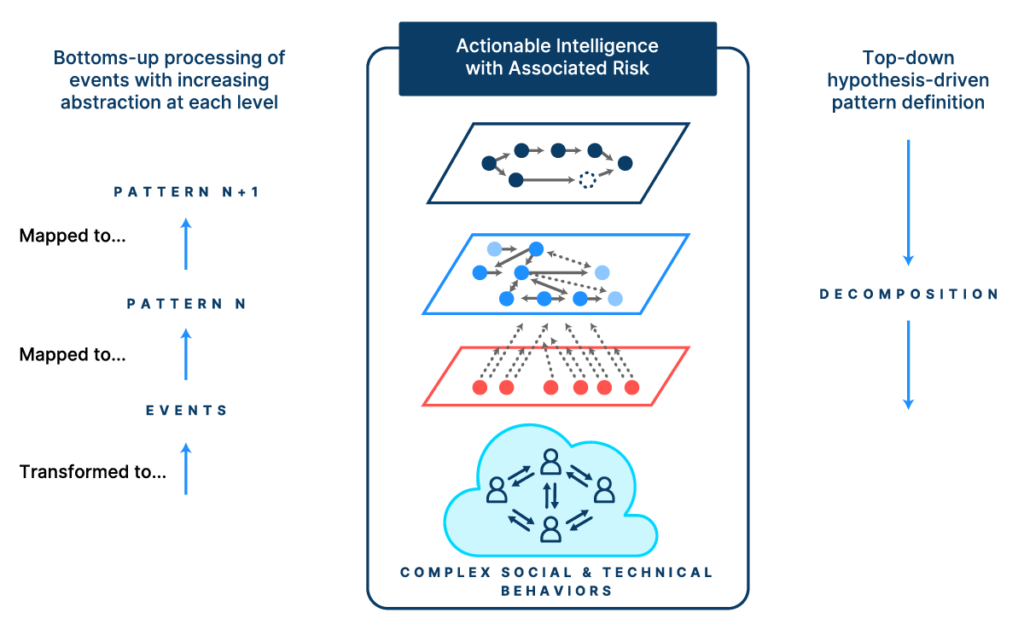
HCEP models problems like human experts do — breaking complex hypotheses into structured layers. This enables:
-
- efficient bottom‑up pattern matching
- avoidance of combinatorial explosion
- abstraction of noise into meaningful narratives
- Stateful Contextual Memory
Where traditional detection resets every day, HCEP remembers:
-
- partially matched patterns
- long‑term behavioral context
- multistep sequences that unfold over hours or weeks
Context turns data into insight.
- Continuous Risk Assessment
HCEP updates risk scores continuously as each new event arrives, enabling proactive forecasting — not reactive monitoring. - Lexicon‑Driven Understanding of Unstructured Text
Human narratives, case notes, reports — they all matter. HCEP extracts meaning from them using hierarchical lexicons tied directly to analytic models. - Human-in-the-Loop Control
Experts can override, adjust, or correct any inference. The system recomputes risk instantly and transparently — a critical requirement in regulated industries.
Proven Across Mission‑Critical Domains
The white paper highlights applications where HCEP has already demonstrated dramatic real‑world value, including:
- Counter‑IED Operations. During Operations Enduring Freedom and Iraqi Freedom, HCEP‑powered analytics enabled junior analysts to generate actionable intelligence in an hour — work that previously took PhD‑level researchers days—effectively scaling expert intuition across the force.
- Insider Risk Management. HCEP integrates the SOFIT insider risk indicator knowledge base – the most comprehensive framework of insider threat behavioral, psychosocial, and technical potential risk indicators – to delivers proactive, whole‑person behavioral analytics allowing insider risk analysts to get left of harm.
Applicable to Many Other Mission‑Critical Domains
- Maritime Smuggling Detection. Cogility’s HCEP model can support maritime‑smuggling detection by encoding expert knowledge about suspicious vessel behavior into hierarchical event‑pattern models. HCEP identifies complex maritime threat patterns such as AIS tracker deactivation and vessel-to-vessel rendezvous. Stateful retention of context enables recognition of multi-step smuggling patterns that unfold over hours, with fully explainable risk assessment.
- Global Finance & Regulatory Compliance. HCEP can provide a powerful, transparent, and scalable expert-AI framework ideally suited for financial institutions facing high-volume data, sophisticated fraud patterns, and strict regulatory expectations while delivering audit-ready transparency.
- Healthcare Enterprise Security. By integrating clinical workflow data, Electronic Medical Records access logs, and unstructured clinical notes, the HCEP model can meet the needs of large healthcare enterprises in managing high-volume, heterogeneous data to combat security threats and provide proactive risk forecasting, all the while protecting sensitive patient information and meeting strict regulatory requirements.
The Bottom Line: Trusted AI for High‑Consequence Decisions
Organizations operating in mission‑critical domains need AI that explains, aligns, and collaborates — not just computes. HCEP delivers transparent and auditable intelligence, and meaningful, actionable insight. In environments where trust is as important as accuracy, HCEP is indispensable.